This is the third and final part of my Netflix trilogy. If you’re landing here first, start with Part 1: How a wedding ring nearly lost Netflix its startup sound to a goat, then go on Part 2: on How Hollywood became tech’s most expensive ad campaign — this piece right here is the payoff for both. Now, let’s roll.
Netflix Won the Battle. Now the War.
Netflix fought the blockbuster wars, outlasted Disney+, Amazon Prime, Max, and Apple, to claim the streaming crown, battle after battle. But like Pyrrhus, every campaign has cost resources, subscribers and margin. The throne stands, yet the ground beneath it shifts; the war was never against the obvious rivals. Actually, YouTube is Netflix’s real threat.
Because attention isn’t split by category; it’s spent. Every hour a viewer loses to a 15-minute video or a livestream is an hour Netflix didn’t win, and no subscriber count offsets that. The real battlefield was never other streamers; it was the open, unbundled, endless scroll — the one arena where Netflix has no “home advantage”.
The competitor quietly claiming that metric doesn’t have a writers’ room, a development slate, or a single Oscar. It has roughly 2.7 billion monthly users, a recommendation engine trained on more viewing behaviour than any studio has ever touched, and content that replenishes itself continuously at zero production cost to the platform itself.
Disney+ was always a known quantity: legacy IP in a familiar wrapper. YouTube is something structurally different, a platform that rewrote what “watching TV” means from the inside out. This is why YouTube is Netflix’s real threat in a way Disney+ never managed to be. The streaming wars were never just about content. Now we can see what they were actually about: the default.
Why YouTube Is Winning the Streaming Wars: The Living Room Has Already Flipped
YouTube Is Not a Mobile App That Wandered Onto Your Television
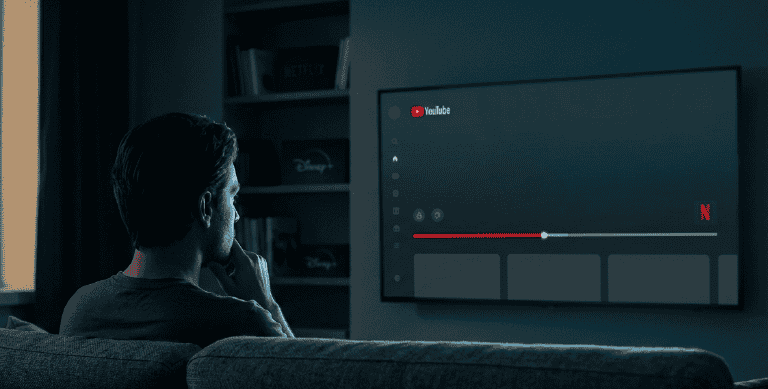
Dismantle the mental model early: YouTube’s fastest-growing screen is the connected TV, not the phone. It’s a living room platform that also happens to work on mobile, not the reverse. As of early 2026, roughly 200 million Americans watch YouTube monthly on their TV sets, and CTV became the platform’s single largest US viewing surface by the end of 2025.
Nielsen’s own data confirms it plainly. Per the Nielsen Gauge streaming market share report for January 2026, YouTube captured 12.7% of all US TV viewing time, against 9.0% for Netflix — a lead it has now held for close to a year running. Disney+ on its own, stripped of ABC and ESPN’s linear numbers, isn not in the same conversation.
YouTube’s content is produced entirely at creator expense. The platform monetizes attention it did not pay to generate.
Netflix vs YouTube Streaming Statistics: What Daily Viewing Time Actually Measures
Global average daily viewing time per account is arguably a more honest metric than subscriber count. It measures engagement, not sign-ups. When YouTube’s per-account daily viewing time consistently outpaces Netflix’s, that isn’t a milestone. It’s a structural verdict about where attention actually lives.

Creator Economy vs Hollywood Production Budgets
Netflix Spends $17B+ to ‘Fill-Up’, YouTube Auto Fills
The financial asymmetry here is almost absurd stated plainly. Netflix’s annual content budget runs somewhere between $17 billion and $20 billion — every dollar an operating cost, a bet on future subscriber retention. YouTube’s content is produced entirely at creator expense (besides maybe negligible YouTube Originals.) The platform monetizes attention it did not pay to generate. In competitive terms, this isn’t an advantage. It’s a different category of business wearing the same clothes.
Speed as an Editorial Weapon
A cultural moment happens tonight. A YouTube creator publishes a 40-minute essay-documentary on it by Thursday, racking up millions of views by the weekend. Netflix’s equivalent response takes 18 months, tens of millions of dollars, and a development meeting. The creator economy doesn’t just compete on cost. It competes on metabolism. Netflix cannot match that speed without becoming something it structurally isn’t.
The Algorithm That Learned Your Couch
Streaming Video on Demand Decision Fatigue Is Netflix’s Silent Churn Driver
The psychology of the subscription couch is underappreciated. Netflix presents unlimited choice to people with finite evening energy, and the result is scroll paralysis in the sense that finding something to watch sometime itself is work. That cognitive load, compounded across thousands of evenings, quietly erodes the felt value of the subscription. To be fair, Netflix has switched gears in understanding subscribers viewing patterns in recent times.
YouTube’s Feed as Frictionless Default
YouTube doesn’t ask you to choose. It already knows. The recommendation engine, trained on billions of sessions, simply begins. There’s no commitment anxiety. A video is three minutes or thirty, and the next one starts automatically. YouTube has solved the “just something to watch” problem in a way Netflix’s interface, despite billions spent on it, structurally cannot or hasn’t, because Netflix still needs you to commit to content it paid for.
The Ad Revenue Collision Course
Netflix’s Ad Tier Didn’t Just Add a Revenue Stream, It Changed Who the Competitor Is
By its May 2026 upfront presentation, Netflix’s ad-supported tier had crossed 250 million monthly active viewers globally, up from 190 million just six months earlier. The moment Netflix started selling advertising at that scale, it stopped competing exclusively with Disney and Warner Bros. for subscription dollars and started competing with Google for advertising budgets. That’s a fundamentally different war, against a fundamentally more experienced opponent.
Netflix defeated every opponent it met. The one it couldn’t fully see had already redefined what “watching something” means on a Tuesday night, when you’re tired, and you just want the screen to decide for you.
What YouTube’s Advertising Infrastructure Means for Netflix’s Ambitions
YouTube’s advertising business is mature, dominant, and deeply integrated into how brands plan video spend, generating roughly $40 billion a year on its own, inside a platform that took in more than $60 billion in total revenue in 2025. Netflix’s entire ad business, by contrast, is projected to roughly double in 2026, to somewhere near $3 billion. Netflix is building toward a destination YouTube has already occupied for the better part of two decades. The gap isn’t just scale. It’s the behavioural data infrastructure underneath, which YouTube has been compounding since 2005.
The Sonic and Cultural Frequency YouTube Controls
YouTube Is Where Sonic Culture Actually Breaks
Before a sound becomes a sync placement, before it becomes a Netflix score brief, before it becomes an Apple brand moment, it almost certainly broke on YouTube first. The platform functions as a de facto global A&R department, trend incubator, cultural thermometer and in some ways a social medium. Netflix reacts to culture. YouTube generates it.
What This Means for the Sync and Composition World
The pipeline for how music enters visual media increasingly runs through YouTube first. A composer, sync supervisor, or music producer who ignores YouTube’s cultural engine is working downstream of the actual source. It’s worth saying plainly, from where I sit in this industry: the sound that will define the next Netflix ta-dum, the next Apple prestige score, almost certainly gets discovered on YouTube weeks or months before anyone in a licensing meeting hears it.
Admittedly, i’ve heard narrative of music supes and producers who do not necessarilly like the idea of sourcing music from YouTube due to Content ID and fingerprinting issues; they may find a song they like and ask composers to create something similar.

Why Legacy Media Cannot Beat YouTube (and What Netflix Still Has)
Narrative Depth, Prestige, and the Appointment Viewing Premium
This is important for intellectual honesty, and it makes the overall argument stronger, not weaker. YouTube cannot make The Crown. It cannot create the shared cultural experience of a prestige drama that an entire country watches and discusses simultaneously. Netflix’s advantage sits in long-form narrative investment, the kind of storytelling that requires cinematic patience and rewards it.
The Question Is Whether That Advantage Is a Moat or a Niche
The risk for Netflix is that prestige long-form becomes an increasingly narrow premium category, valued deeply by a shrinking share of total screen time while YouTube quietly absorbs the ambient majority. Netflix could win every Emmy, Oscar and Tony on the table and still lose the living room. That tension is the real story of where this goes next, and it’s the clearest evidence yet that Netflix’s true competitors were never the ones it spent a decade fighting in the open.
Conclusion: The Default Wins. Always.
Netflix defeated every opponent it met. The one it couldn’t fully see had already redefined what “watching something” means on a Tuesday night, when you’re tired, and you just want the screen to decide for you..
The streaming wars were fought on the wrong terrain. Content quality, IP libraries, Oscar campaigns — these were the visible battlefields. The invisible one was frictionlessness: who becomes the effortless, automatic choice when human attention is most available. YouTube answered that question even before Netflix thought to ask it.
I’m thinking perhaps, Netflix could start experimenting with UFlix, Netflix+ — whatever branding it can come up with — and user-generated content system, where creation and consumption are both decided by the users. That way, it grab back some of the territory it’s loosing; whichever direction the sword swings, its double edge cuts something.
The streaming wars began with a sound. Then escalated into a business model. And they were always going to be decided by whoever controls the most effortless choice. That answer, for now, lives in Mountain View, and it has been there the whole time.