We’ve all at some point seen the headlines. Taylor Swift re-recording her entire back catalogue. Iconic 90s hip-hop pioneers suddenly appearing on Spotify after decades of silence. Mega-stars changing their names to unpronounceable symbols.
To the casual music fan, the business side of music doesn’t look interesting. It is a rigid, drama-laden two-hundred-year-old legal framework. It however simply require you to understand its core mechanics and the entire industry suddenly makes sense. If you’ve read my my producer contracts piece, you already met the clause that hinges on all of this.
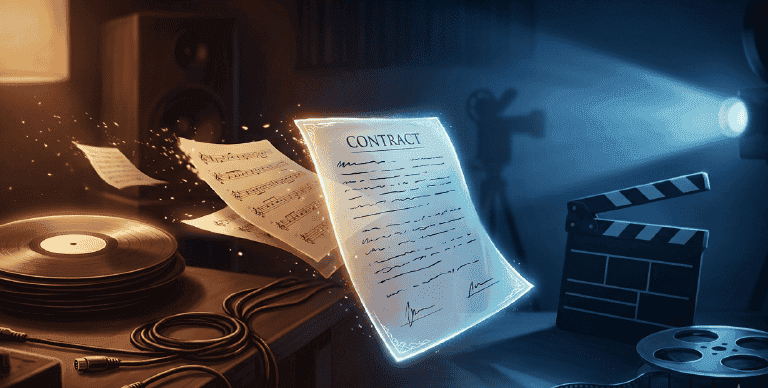
If you want to understand music publishing vs. masters, and how music power dynamics work today, you only need to understand two concepts, which the U.S. Copyright Office treats as two entirely separate works: the Blueprint and the Brick.
The Blueprint (The Composition Copyright)
Think of a song like a house. Before a single brick is laid, an architect has to draw up the blueprint. In music, this blueprint is the composition: the abstract lyrics, the melody, the chords, and the sheet music. This is the first half of the music publishing vs. masters equation, and the half most new songwriters understand best.
Who owns it: Songwriters, lyricists, and composers.
How it pays: Through publishing royalties (performance, mechanical, and sync). Every time the song is covered, streamed, played on the radio, or sung at a karaoke bar, the architect gets paid.
The reality of split sheets: If five people sit in a room and write a song, they split this copyright. A traditional publishing contract often means selling a piece of this blueprint to a corporate publisher in exchange for a cash advance upfront and help getting the song placed in film or TV.
The Brick (The Master Copyright): Who Owns Master Recordings
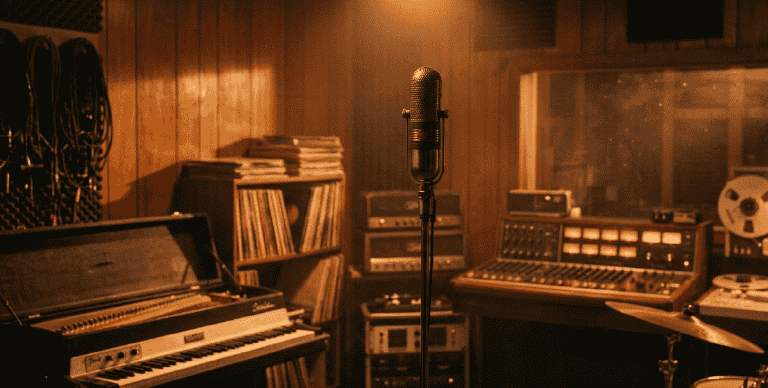
You can have a brilliant blueprint, but you can’t live inside one. Someone has to buy the concrete, hire the builders, and physically construct the house. In music, that physical house is the master recording: the actual audio file, the WAV, the specific performance captured on tape or in software. Who owns master recordings has historically been a separate question entirely from who wrote the song, and that gap is where most of the industry’s power struggles actually happen.
Who traditionally owned it: The record label.
How it works: Historically, labels acted as the bank. They paid for the expensive studio time, the session musicians, the mixing engineers, the marketing, and the global distribution. In exchange for taking that financial risk, they took 100% ownership of the master.
The trap: The artist got a small percentage of sales to clear their debt to the label, but they didn’t own the property. If the label wanted to sell those masters to a third party, or license the song to a commercial the artist hated, the artist had zero legal say.

The Golden Cage: Why the Blueprint Isn’t Enough
For decades, artists were trapped in a frustrating paradox: they owned the blueprint, but not the brick. Signing away your masters at the start of a career, often the only leverage a new artist has to offer, is still the default in most standard label deals; understanding music publishing vs. masters before signing anything is the single best protection a new act has.
If you only own the blueprint, you can easily be locked out of your own property. You can watch people stream your music by the millions, but the lion’s share of digital streaming revenue goes directly to whoever owns the master copyright. Music royalty splits explained on paper rarely match what artists expect in practice, and independent music ownership is rarely offered; it usually has to be negotiated for, or built from scratch outside the traditional system. You have the cultural legacy, but you don’t have the corporate control.
“If you do not own your masters, your master owns you.” — Prince.
In one of my favourite punchlines. Pharoahe Monch puts it: “slave to a label but I own my masters…” To understand how devastating the golden cage can be, we only have to look at two legendary cautionary tales.
The Cautionary Tales: Prince and De La Soul
Prince: “On Record, Slave”
In 1993, Prince shocked the world by appearing in public with the word “SLAVE” scrawled across his face and changing his name to an unpronounceable “Love Symbol.” Why? Because under his 1977 Warner Bros. contract, the label owned his master recordings and the trademark to his own birth name.
Prince was incredibly prolific, writing music faster than the label wanted to release it. Because Warner Bros. owned the masters, they legally controlled his output rate to maximise their corporate profits. Prince’s protest wasn’t about a lack of money; it was about a lack of bodily and creative autonomy over his own labour, and it remains the most famous cautionary tale about signing away your masters in the history of the industry.
De La Soul: The Streaming Era Ghost Catalogue
For over fifteen years, one of the most influential catalogues in hip-hop history, including the iconic 3 Feet High and Rising (1989), was completely missing from Spotify, Apple Music, and YouTube.
Because their original label, Tommy Boy Records, owned the master recordings, De La Soul had zero power to put their own music online. In 2019, the label offered the group a streaming split that would have handed them just 10% of the proceeds, with Tommy Boy keeping the rest; negotiations collapsed, and the group publicly urged fans to boycott the label rather than accept the terms.
Few case studies illustrate music royalty splits explained in plainer terms: it’s the clearest example of what a total lack of independent music ownership actually costs an artist in real money.
It wasn’t until 2021, when Reservoir Media acquired Tommy Boy’s catalogue, that De La Soul finally won a fair deal. Their music reached streaming on 3 March 2023; a bittersweet victory, arriving just three weeks after the passing of co-member David “Trugoy the Dove” Jolicoeur.
Enter the New Guards: How the Rules Were Rewritten
The old-school corporate machine relied entirely on the fact that artists couldn’t afford to build the house themselves. But technology, internet infrastructure, and legal awareness changed everything. Once enough songwriters understood the difference between composition copyright vs. sound recording, the leverage in the room started to shift.
The Taylor Swift Playbook (The Ultimate Leverage)
When Taylor Swift’s old label sold her master recordings to a private equity firm against her wishes, she executed a flawless legal chess move. Because she retained her rights as the songwriter, she used her veto power to block the new owners from licensing her old music to TV and film. Her fight was, at bottom, a fight for creative freedom in the music industry, not just for a bigger cheque. Then she went back into the studio and built brand new houses: the “Taylor’s Version” re-recordings.
By steering her fanbase to the new masters, she tanked the financial value of the old ones so thoroughly that, in May 2025, she was able to buy the original masters back outright for a reported $360 million: full ownership of both the blueprint and the brick, achieved from a position of leverage she built entirely herself.
The Independent Production Revolution
Today, a producer or artist doesn’t need a million-dollar major label budget to lay a brick. You can record a hit on a laptop in a bedroom, distribute it globally via an independent distributor for a small annual fee, and market it directly to millions via TikTok. Just as the Billie Eilish/Finneas exprience, a lot of new and independent artists now follow this route. Composition copyright never left the songwriter’s hands in this model; now the master copyright doesn’t have to leave either.
Because the cost of creation dropped to near zero, the new generation of creators is walking away from traditional contracts, funding their own records, bypassing the major label ecosystem entirely, and treating independent music ownership as the default rather than the exception. Signing away your masters is no longer a necessary evil; it’s an avoidable mistake.

The One-Stop Advantage: Why Sync Composers Need Both
Here’s where this stops being abstract for anyone pitching music to film, TV, or games. Music supervisors work under brutal deadlines, and the single fastest way to kill a placement is a split rights holder. If the composition and the master are owned by two different parties, a supervisor now needs two signatures, two negotiations, and two invoices before a cue can even be locked to picture.
Today, a producer or artist doesn’t need a million-dollar major label budget to lay a brick. You can record a hit on a laptop in a bedroom, distribute it globally via an independent distributor for a small annual fee
This is why “one-stop” clearance has become the most valuable phrase in sync licensing. When a composer owns both the blueprint and the brick, as most independent production music composers do by default, a supervisor can clear a cue with a single email and a single contract. That speed advantage is often worth more than the fee itself; a mid-budget doc or streaming series will choose the one-stop cue over the better song every time, simply because it closes faster. Music publishing vs. masters stops being a philosophical debate the moment a deadline is involved.
It also explains why the producer contract you’re negotiating matters just as much as the song you’re writing. If you’re still asking how music publishing contracts work in practice, the short answer is: they decide, years in advance, whether you’ll be a one-signature composer or a two-signature problem. A work-for-hire clause that quietly assigns your master to someone else doesn’t just cost you royalties down the line; it turns your own catalogue into a two-signature problem the next time a supervisor comes calling.
The Takeaway
The modern music industry isn’t just about making hits anymore; it’s about retaining creative assets.
The old guard taught creators to be content with just being the architect. The new guard, and every composer building a one-stop catalogue, has proven that if you want true creative freedom in the music industry, generational wealth, and a sync catalogue that actually gets placed, you have to design the blueprint and own the bricks.
At its core, this is what music publishing vs. masters actually comes down to: not a technicality buried in a contract, but the difference between renting your own legacy and owning it outright. Whoever ends up asking who owns master recordings on your catalogue years from now, the answer should be you; and independent music ownership, once a rare exception, is fast becoming the standard every serious songwriter and composer should be negotiating toward from day one.