You generated a track in seconds. It sounds polished and release-ready. You upload it. Maybe even shared it with a few people. Everything is so easy, it feels like magic… But that was because the real issue with AI music or AI-generated music doesn’t show up when you create; it shows up when you try to do something serious with it.
You might say “everyody is now doing it,” yes they may be doing it and that is partly too easy but then the penalty can be hard and “costly” tooy. Also, before going further, I’d like to say that the school of thought I lean towards is not necessarily against Artificial Intelligence use in itself, (almost everybody does) but rather against letting AI do all of the work while you chill.
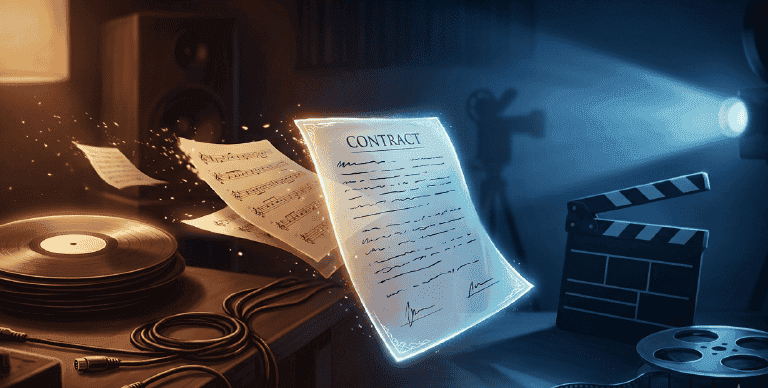
Under current legal frameworks like the 2023 US Copyright Office rulings and similar EU leanings, AI-generated output without human intervention cannot be copyrighted. As it stands, if a creator generates a song entirely via AI music makers and prompts, they don’t legally own the master or the composition, and that is the basis for my “TED Talk” today.
Now, let us imagine a creator writing prompts, generating polished tracks one after the other in seconds and getting excited about his catalogue. Ordinarily, it looked like he is making progress and accomplishing something, but in the real sense, he is actually walking into quicksand.
Actually, what he has done is command a tool to create “assets”, but unfortunately, he doesn’t really “own” the assets even though he appears to have created them; sounds weird, right? Walk with me.
The Illusion of Ownership
As a creator, can you own AI-generated music? Many AI music platforms hide ownership clauses in their Terms of Service (ToS). Users often discover too late that the platform itself retains the rights to the underlying generation, granting the user only a non-exclusive licence to use it much later on.
The law doesn’t protect machine-made art. If a machine made it, it belongs to the public domain.
As most people know, AI does not actually create; it scrapes the internet for created content, aggregates and presents them. So your AI-generated song is an average of other people’s works.
You might use a premium subscription to create a recording, but you don’t own the master. Admittedly, most of us rarely read the ToS on websites; I mean, we hardly have the patience. If you plan to use music generated from an AI platform, however, you must read their Terms to know where you stand.
If you care to know why music supervisors, sync licensing agencies and even streaming platforms are sceptical about dealing with AI music, the simple answer is they are avoiding legal risks associated with clearing it. If they can’t protect their business against future claims, then it’s better they don’t deal.

How AI Music is Actually Made
The Statistical Average
AI works by looking at patterns to predict the next note. It aggregates several published songs and studies them in what is known as “learning”; it then recreates something similar based on the prompt given. Real music creation requires the heart and the brain; AI might have the “brain”, but it does not have the heart.
You may still remember the TikTok user, Ghostwriter977, who uploaded “Heart on My Sleeve,” a track that sounded exactly like a collaboration between Drake and The Weeknd. Even though there was no sampling, their voices were unmistakably obvious. The song racked up 600,000 streams on Spotify before it was pulled, with revenue estimates ranging from around $1,900 (per the BBC) to roughly $9,400 across all platforms (per Billboard). Universal Music (the parent label) fought to get the song deleted. The incident brought attention to what AI tools could do to music, arriving the same year as the US Copyright Office guidance mentioned earlier.
Actually, what he has done is command a tool to create “assets”, but unfortunately, he doesn’t really “own” the assets…
The law doesn’t protect machine-made art. If a machine made it, it belongs to the public domain.
Prompt engineering can allow anyone with a computer and internet to simply type: “Hey Suno, make me a song titled ‘Sorry, I’m Not Sorry’. The song should blend Billie Eilish, Ariana Grande and Taylor Swift voices and styles” and the tool will do exactly that in ten seconds, even though that style does not even exist yet. Of course, the idea sounds ingenious, but it’s actually a fraud.
What “Ownership” Actually Means in AI Music
Who owns AI-generated music? When AI musicians ask, “Do I own my AI-generated music?”, they’re usually thinking in terms of “Can I use this? Can I upload it? Can I make money from it?” But ownership in music goes deeper than that; it’s not just about access, it’s about control, exclusivity and long-term leverage. With traditional production:
- You created the composition
- You control the master
- You can prove authorship
- You can defend your work
In other words, you can “show your workings”. The stems, the co-songwriters, the producers, the mix engineers, and the sessions are evidence of what you’ve created. It is much easier to prove you own it; the opposite is true of AI-generated music.
The Reality of AI Music Rights (Suno, Udio, Aiva & Others)
Platforms like Suno AI and Udio have made music creation incredibly accessible. And to be fair, many of them do grant commercial rights, especially on paid tiers. But here’s the nuance most people overlook in suno ai ownership rights, udio ai commercial rights etc:
- Rights are often non-exclusive
- Outputs can be similar across users
- Terms can change over time
- Your “ownership” is often tied to platform conditions
So while you’re not entirely being misled outright, you’re also not getting the same level of ownership you would with traditionally produced music. And that difference becomes very real… very quickly.
5 Ways Artists Find Out the Hard Way
You won’t notice these issues while creating. You’ll notice them when opportunities, money or growth are on the line.
1. The Sync Deal Quietly Disappears
Your track luckily lands a potential placement on a major film, TV, ad or trailer, and they ask for ownership clarity, exclusivity and rights documentation. Then things stall. Why? Because AI-generated music raises questions you can’t confidently answer. Is it truly original? Can you guarantee exclusivity? Eventually, that uncertainty leads to a lost deal.
2. Content ID Conflicts & Claims
You upload your track to YouTube. Then your track gets flagged, or someone else’s similar AI-generated track triggers a conflict. Now you’re stuck. A dispute over true ownership begins between you and the other AI creator; you know how it’s going to end, right?
The ownership dispute spirals into lost revenues, possible YouTube strikes, demonetisation and, in the worst case, a channel ban. It can be even more painful if it’s a channel you’ve nurtured and invested in for some time. It means starting all over. Really, I don’t think it’s a very good strategy if you are playing for the long haul.
Use generative tools for brainstorming, arranging ideas, or breaking writer’s block, but recreate, replay and rearrange the final elements yourself.
3. Platform Terms Changes
Like I mentioned earlier, most people do not read Terms of Service, and even if you do, some AI platforms could argue they reserve the right to update their Terms without prior notice. So the fine print you thought you read and even PDF-ed in your Google Drive becomes useless. You soon discover that you still have all the music you’ve generated, but you’ve lost the rights to use it.
4. Distribution Issues & Takedowns
Music distributors are becoming more cautious with AI-generated content; this often hits artists by surprise, especially when everything seemed fine during upload. Possible outcomes include flagged uploads, delayed releases, royalty seizure and possible removal due to unclear ownership.
5. No Stems, No Flexibility
Even though music technology is advancing at a fast pace, there are now tools that try to separate an AI recording into stems; they are still not yet perfected. Nothing beats the confidence and flexibility of owning your stems from the ground up, and that is only possible if the material is your original composition.
Whatever DAW you choose, you always have access to all the project files, instruments and effects you used to create the track, giving you the comfort to iterate: changing notes, chords or arrangement, with full control over anything at all. That is not the case with AI-generated music.
With AI-generated music, you often just have the final output. That makes it almost impossible to customise tracks for clients, create alternate versions or adapt tracks for different formats, and so on.
How to Use AI Without Losing Your Rights
As a Sketchpad, Not a Finished Product
Use generative tools for brainstorming, arranging ideas, or breaking writer’s block, but recreate, replay and rearrange the final elements yourself.
Document Your Process
Keep your project files, MIDIs, stems and voice notes. If your ownership is ever challenged, your DAW session is your ultimate proof of human creation.
Post-Production
Of course, you can use AI in mixing or mastering, as those are not the “soul” of the creation itself; they are the garnishing and optimisations that make the original song sound the best it possibly can.
Thoughts to Keep
Go read the ToS of that AI tool you’re using now! You don’t have to wait until a track blows up to have the rug pulled out from under your feet. Keep the “soul” and the copyright in your hands.
DistroKid says they accept AI-generated music; the conditions? I pray you can meet them. Same for LANDR; at the time of writing, the policies can change any time. Their approach seems to be saying: when dining with the Devil, use a long spoon.
With multiple ongoing disputes and court processes by organisations like the Recording Industry Association of America (RIAA) and major labels, it may be wise for creators to tread that path with caution.
Is Suno AI music copyright safe? It is laughable to try to build a house on land that is not yours; it’s just as much a losing game to claim ownership of digital assets that are not explicitly and exclusively yours. The odds are stacked against you. At least that is how I see it for now.
If you enjoyed this piece, you may also find the code, cash and chords post, and can i copy-protect my chord progressions and the follow it up by checking out 8 Ways to Legally Use Published Songs and maybe Mastering for Streaming: 5 Reasons Your Mix Sounds ‘Bad’ on Spotify. Hopefully, you’d like them too